
My work is based on a desire to reunite what has been separated; specimen, land, name, memory. To think about what questions might arise from bringing these fragments together. (Anna Atkins Fragments of Stories)
Author: Provocations Project
Shannon Cuykendall
Ruby Lawrence


Xuefei Yang
How do machines learn what age is supposed to look like?
This provocation explores how AI systems both estimate and generate age through two connected experiments. The first examines how an age estimation model predicts age under controlled changes in hairstyle, eyewear, and clothing. The second investigates how image generation models visualise “22-year-old,” “35-year-old,” and “50-year-old” East Asian women wearing glasses.
Across both experiments, age emerges not as a fixed biological category, but as a relational visual construction. In the estimation experiment, predicted age shifts according to facial framing, contour visibility, and the interaction between hairstyle and eyewear. In the generative experiment, age is distributed across interiors, clothing, accessories, and atmosphere, with older women associated with increasingly ordered and middle-class environments.
Rather than simply recognising age, AI systems participate in constructing visual expectations of what age should look like.


Tanaka Brenton
I’ve made over a thousand beats. Started in 2011. And I still can’t fully explain what happens in the moment a track stops being just a track.
It’s not technique. I know technique. It’s something that arrives or it doesn’t. You feel it before you can name it. The arrangement settles in a way that feels less like a decision and more like a recognition.
I built a whole framework trying to hold it. Trilingual. Theological. Cinematic. It works but only around the edges. The centre of the thing still won’t sit still long enough to be explained.
The gap between craft and that other thing, that’s what I keep circling. Discipline gets me to the room. But something else determines what happens inside it.
Thirteen years in. I still can’t teach that part. So I just keep creating the conditions and showing up.
Rosie Enys
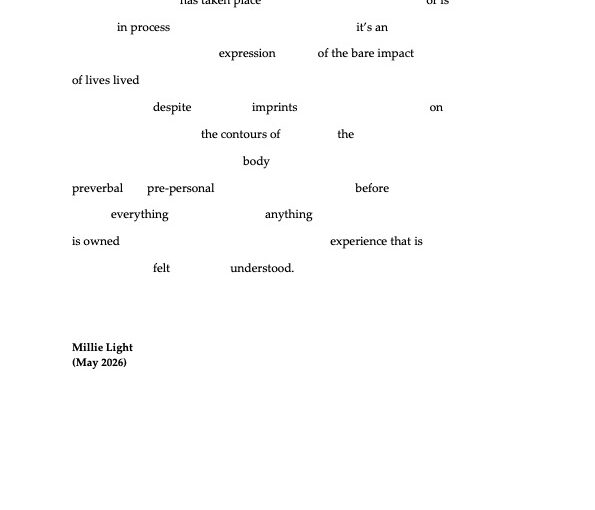
The performance of research explores the interconnectedness of knowledge and ideas. The practice strives to find the space or conversations in which your emerging and glimmering spark may gain energy and vibrancy.
The spark is an ineffability that needs to gently be held and nurtured before words are found to bring about its form and draw it into relationship with other research. But how do you discover connections without words?
Search engines demand keywords or questions, library classification systems require subject identification, human conversations seek a shared language. Knowledge systems are wrought with problems. Discovery tools are riddled with innate human biases, yet we are so easily beguiled by the illusion of algorithmic certainty.
Intentionality is both necessary and limiting. So much is visible and so little is seen. Whilst steeped in the powerful and fragile liminality of poiesis, embrace serendipity before diving into the opacity of the ‘known’.
Millie Light

Sophie Craven
Where is god? Unanswerable. First breath of the universe; ancient sacred texts containing both breath and primordial waters; Turner’s ‘the sun is god’; a weeping eye in a waterfall; a butterfly under the surface of a river; a circle of standing stones; the tide pulling in and out, sucking stones; a memory palace; a grandmother’s voice patterning through raindrops on wild garlic; the ley line meeting place at Castle Beach, at ancient Glasney. Where is god? The old god – omnipotent, omnibenevolent, omniscient – is dead. How might we build a new dwelling place for the gods now? In land, in bellies and hearts, in process, in attention. How can we hold a sense of the sacred when all is profaned, bureaucratic, polluted? I walk in the woods every day and ask the gods to walk with me. Sometimes they do, I think.