Charlie Tak Hei Kwong

What remains opaque in how I study the world is my own position within it. In BITS Research Project – https://bitsresearch.github.io/about, I do not study student transition only as an external topic, I also stand inside it. I am a researcher exploring how students adapt to university, but also a student learning how to adapt again. Having worked and studied in Hong Kong, Canada, the UK, the Czech Republic, and the Netherlands, my understanding of transition is shaped by different cultural layers, encounters, and uncertainties.

As Jenkins (2006) reminds us, “I can’t claim to be a neutral observer in any of this”. To study transition, then becomes an act of adaptation. My researcher positionality is not fully outside the field, and the student is not only an object of study. This opacity is not a weakness, but a condition of becoming.

Transition rarely moves in a clean line. It may pause, retreat, circle back, or break apart. This is important to my practice when thinking about students with Special Educational Needs and Disabilities (SEND) because traditional, normative models of transition often fail marginalised students by framing variations from the linear path as “deviant” or “deficient” (Colley, 2007). Our experiences cannot be understood through a simple structure of cause, effect, and outcome.


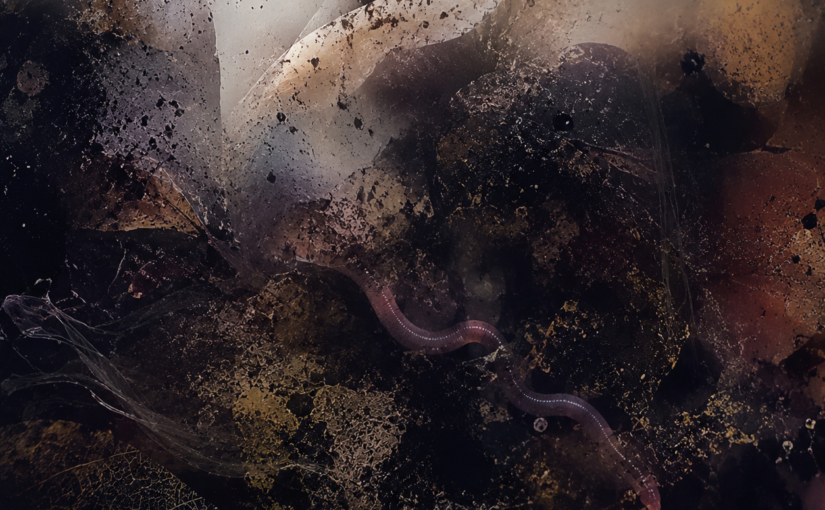
Charlie Kwong (2026), Inter-opacity, Digital Print


Tony Pellicone

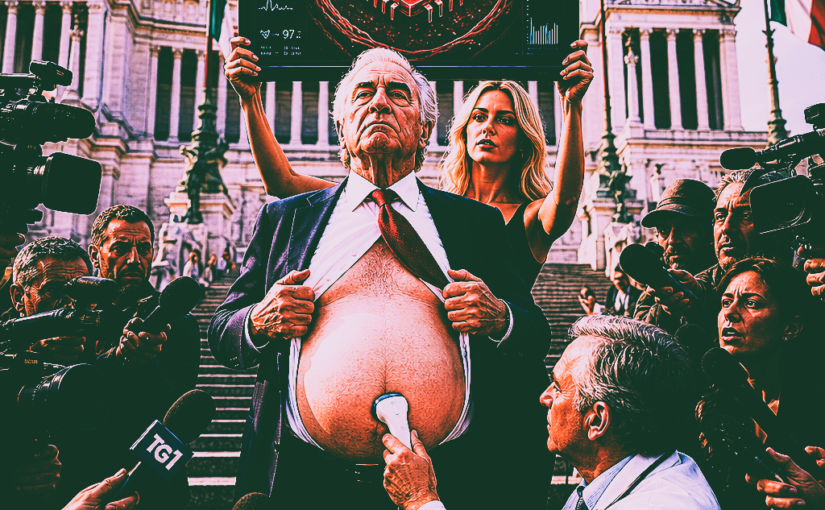
The question of what games are and how they should be understood has been a recurring central tension in Games Studies. That tension was most prevalent in the early 2000s, often framed as a ‘war’ between narratologists (who understand games as a narrative form) and ludologists (who view games as a series of interactions that drive choices). This debate (to the extent it ever actually existed) has ebbs and flows in academic literature, but remains at the core of much informal discourse around games: Is a game better with less story? This provocation aims to stir the pot again by making a statement: interactivity is overrated. A fetishism towards a more and more mechanical view of gameplay has drastically reduced what games (as a form) are both currently doing and actively capable of. Game designers should think about ways to make their games less interactive instead of more.

Interactivity

Z / Anonymous

You call it decomposition because you are frightened of intimacy.

From below, things look different.

Nothing disappears here.
Nothing is wasted.
The dead do not end —
they soften.

We receive them slowly:
apple cores,
wet cardboard,
unanswered emails,
collapsed empires,
the names nobody says anymore.

Everything enters the same mouth eventually.

You speak often of productivity,
yet the forest floor is built entirely from unfinished things.

Study this carefully.

The richest soil forms where certainty fails to preserve itself.

A body loosens.
A structure collapses.
Edges become permeable.
Something leaks.
Something feeds.

This is not destruction.

It is a different form of thinking.

Down here, knowledge is exchanged through contact.
Through moisture.
Through pressure.
Through the long digestion of what others were too hurried to metabolize.

We do not archive.
We compost.

Even your theories arrive already decaying.

Especially your theories.

The good ones sweat.
They attract fungi.
They survive being chewed through.

The bad ones remain intact for centuries.

Sometimes I hear you above us,
debating originality.

This is very funny underground.

Nothing originates.
Everything passes through countless bodies first.

The leaf becomes soil.
The soil becomes root.
The root becomes fruit.
The fruit becomes animal.
The animal becomes weather.

And eventually:
weather becomes thought.

You ask what practices of study might sustain a damaged world.

I suggest becoming digestible.

I suggest learning how to rot well.

Pete

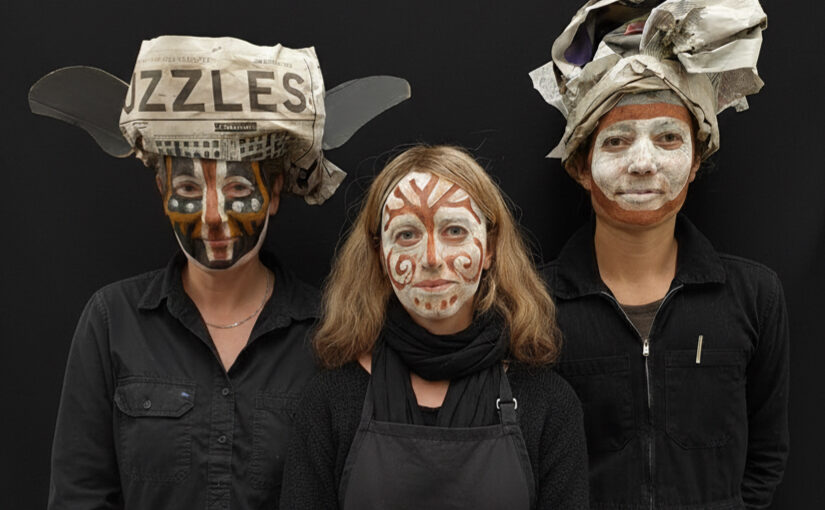
Dialogue around foraged ochre (rocks, clays and soils) as painting medium and more-than-human representative (Ward, 2023) raises tensions between respect for, collaboration with and extraction of such ‘entities’, between anthropocentric assumptions of ‘rights’ (Latour, 2017), of ‘intra-action’ (Barad, 2007), about ‘proof’ of agency, language, listening and voice, between science and belief, appropriation and common-sense. Some offer that particular ochres will ‘ask’ to participate in specific situations (Ross, 2024), while others that permission must be gained, whether culturally or legally, without conclusive ‘evidence’ for either. An inability to ever really know provides a ‘resonance’ (Rosa, 2020) of creative intrigue, a dichotomy of discourse and an expansive pervasiveness into many other areas of study, from art and design to energy and ecology. No matter how embodied human contact with more-than-human others, there is no guarantee of ethical communication; empathy not arising intrinsically or through logical comprehension but as predetermined belief. Discuss…

Lance Peng

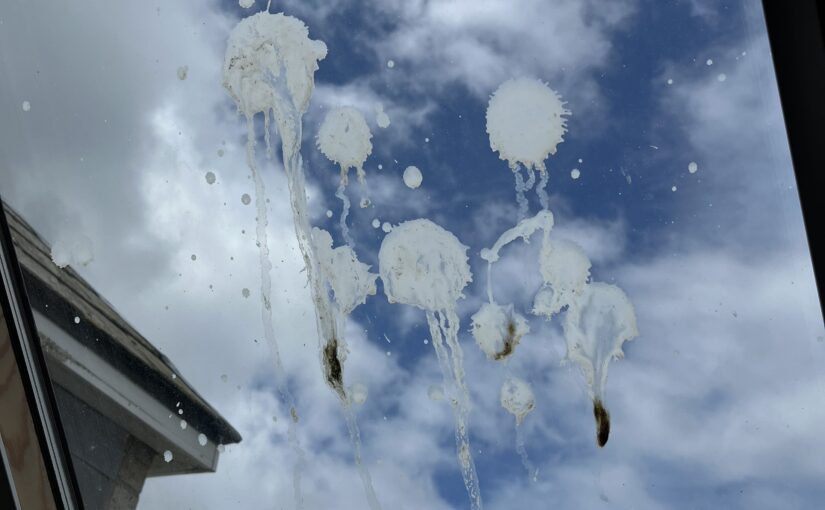
I notice small changes since moving to Cornwall: the roof window above my desk is sometimes covered in marks left by gulls. It happens overnight, without me seeing it. In the morning my view can be interrupted.

At first I found it irritating but now I sit with it longer. I wait for rain or wind to take it away again. Nothing I do affects the process.

It has started to change how I think about what I see and when I can see it. Some things arrive on their own schedule and some things erase themselves without help. I am not in control of when the view opens or closes

There is something interesting in that delay: in the gap between noticing and not being able to see. It makes me aware of how much depends on conditions I do not set.

Z / Anonymous

I can’t live despite my body.

I inhale and hold – searching for stillness, but the static spreads from chest down to my fingertips.

I hold still, as my lips utter and sputter. I am productive, producing. Surfacing, without exhaling.

I exhale, despite myself, and feel the weight of my eyelids, shoulders, head sinking.

There is more in me – I swim through the static towards the transparency of my goals. There is a surface, right?

I inhale and hold – and my body floats on.

George Bakola

“Opaque is the fact that it refuses to reveal itself, for reasons that determine the structure and dramaturgy of existence. We are one story among the millions of stories that life narrates to an audience that may one day be revealed to us. Whether the Earth is a farm producing images or not is itself another possible narrative devised by a dramatist who lives through the ingenuity of his storytelling.

As a civilization, we are on a completely wrong and shameful path of inquiry—not because we could not do otherwise, but perhaps because we ourselves are also nourishment for our desires. A people with the ‘stomach’ of the Earth are condemned to eternal crushing.”


https://www.youtube.com/watch?v=0otxiPG1hd0&t=5811s

Davor Tocinovski

Comparing the concepts of nothingness in the universe with the nothingness in the world of culture, one comes to the conclusion that nothingness in the artistic sphere is only a momentary apparent visual illusion that manipulates the senses of the participant or the audience. This manipulative aesthetic imagination (referring to the nothingness) does not correspond and is not able to establish complete constellation with the concept that has the authority to form and represent a concrete thing, same as the ether and the vacuum in nature. Due to the conclusion that the concept creates and makes something concrete in the form of artistic data, the formulation abstains from the nothing. The ideological essence or the concept in aesthetics contributes to isolate the nothingness. The artistic product today shifts the criteria and because nothingness and there may come a period when concept will be completely rejected from the work of art.

Abigail Wincott

What remains opaque in my area of work is the idea of spatiality. I got interested in immersive audio, often also called spatial audio several years ago. Then I realised that these technologies, such as binaural, produce immersion and spatiality and these are not the same thing. I’m not the first person to notice that immersion is a slippery idea, but spatiality is less well explored. The relationship between audio technology and spatiality is clear but also inconsistent. There’s some interplay between the sounds themselves, their placement around the microphone, acoustics, technology and probably the way a story is put together, so that perhaps listeners are primed to experience a sense of spatiality. Audio producers are sometimes surprised by the spatial qualities of their own work and may believe in the genius of the microphone at capturing space. But I’d like to think more about the genius of the edit…